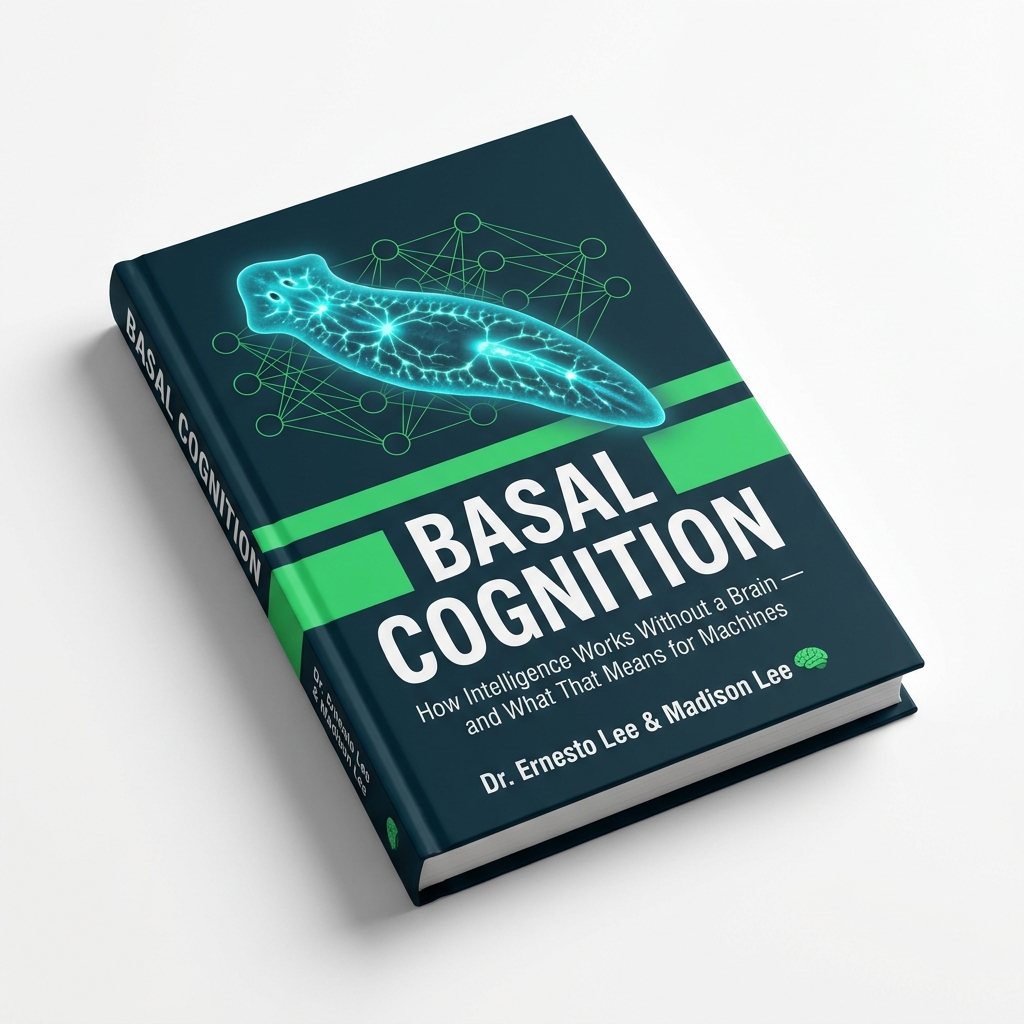
Figure 1:Basal Cognition · Dr. Ernesto Lee
1Basal Cognition
1.0.1How Intelligence Works Without a Brain — and What That Means for Machines
Dr. Ernesto Lee · BasalCognition.com
1.1The thing that shouldn’t be possible
Cut a planarian flatworm into 279 pieces. You do not get a pile of dead tissue. You get 279 flatworms — each one a complete animal, each one rebuilt from whatever fragment it started with. They move. They hunt. They know what shape they are supposed to be. And when each one is done, it stops.
That stopping is the thing nobody can explain.
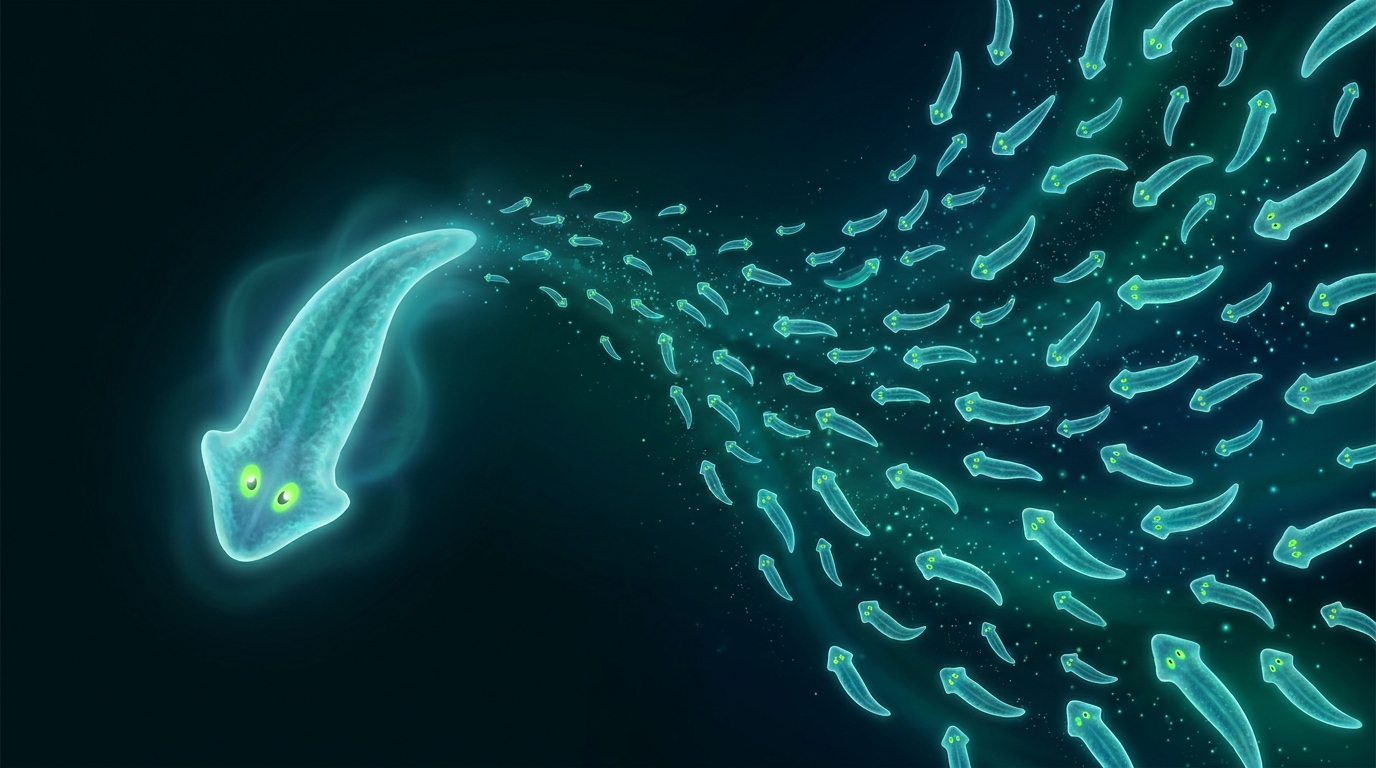
Figure 2:Cut it into 279 pieces. Get 279 worms. Each one stops when it’s done — and the stopping is harder to explain than the growing.
Brains did not invent intelligence. They scaled it.
In 2020, Michael Levin and Josh Bongard scraped cells from frog embryos — plain skin cells, the kind that would have become the outside of a tadpole — and let them sit in a dish. With no further instruction, those cells assembled into small swimming creatures that have never existed in evolutionary history. In 2023, Gumuskaya and colleagues did it again with human cells from the airway. The resulting organisms cleared dead tissue. They moved with what can only be called purpose.
These things had no brains. No neurons. No evolutionary precedent. They just did it.
Intelligence is not what brains produce. It is what matter does when it organizes.
Here is the objection that comes first. “These are just reflexes. Chemistry following chemistry. You’re projecting agency onto physics.” It is a fair objection, and this book earns its answer. The short version: reflexes are not self-correcting. Reflexes do not recover their target when you block the usual route. Flatworm fragments do. Slime mold does. In 2000, Toshiyuki Nakagaki showed Physarum polycephalum — a single-celled organism with no brain — solving a spatial maze. In 2010, Atsushi Tero showed the same mold reproducing the Tokyo rail network, the one that took Japanese engineers decades to optimize, in 26 hours.
The right question is not is this intelligence? The right question is how much intelligence, of what kind, and what levers can I pull to change it?
That is what this book is about.
1.2The six ideas
The framework underneath this book is TAME — Michael Levin’s Technological Approach to Mind Everywhere. Six ideas. One chapter each.
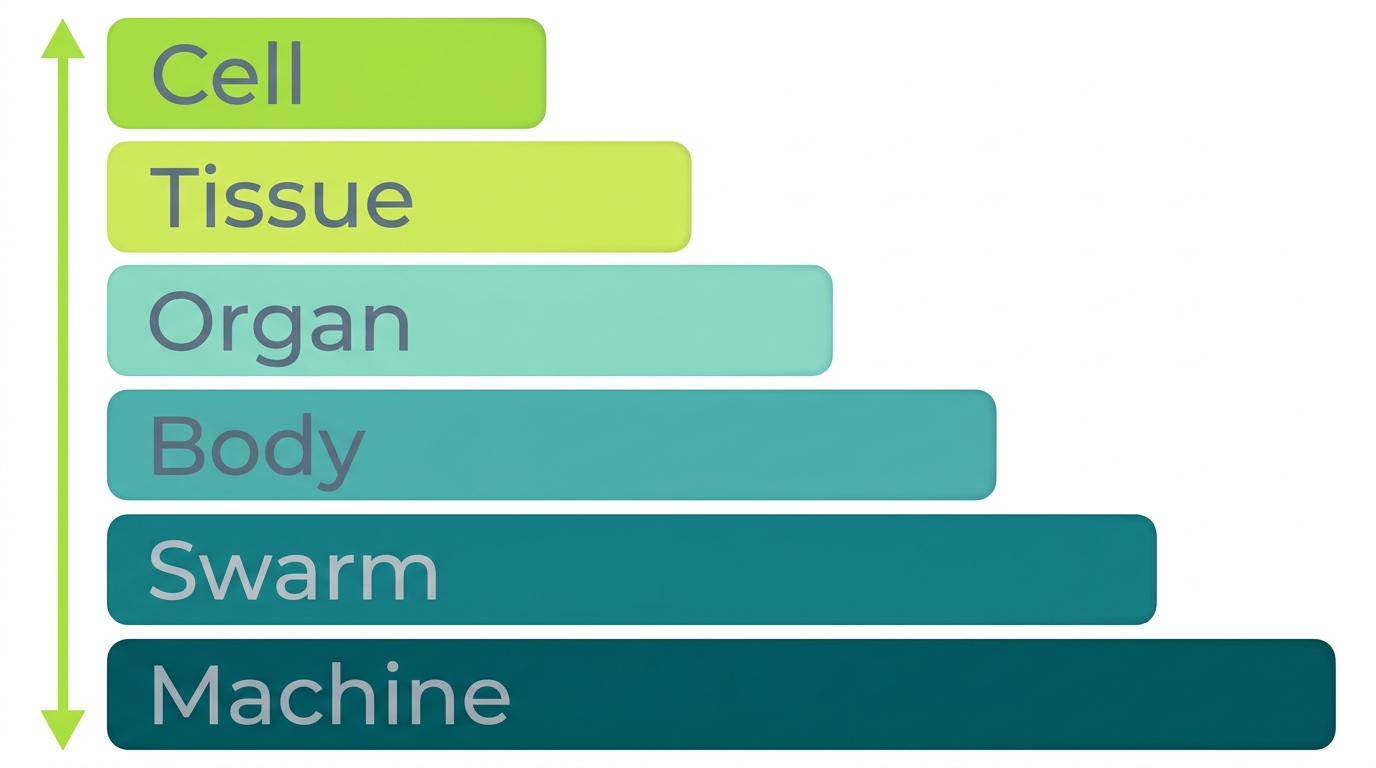
Figure 3:The six ideas climb the same ladder: from molecule to machine, each level has a version of the same cognitive property. The question is how much, and how wide.
2¶ | The Idea | What It Actually Means (and Why It’s Surprising) |
|---|---|---|
1 | Smartness comes in degrees | A clock isn’t smart. A slime mold is a little smart. You are very smart. The surprise: this is measurable, not metaphorical. Where a thing falls on the scale tells you which lever to pull — tools for a clock, rewards for a dog, arguments for a person. Chapter 2 shows you how to read the dial. |
2 | The cognitive light cone | Some things care about right here, right now. Others care about building a hand over six weeks, or a city over a lifetime. That caring radius is the main thing to measure. Cancer is what happens when a cell’s radius collapses to zero — it stops caring about the body it lives in. Chapter 3 maps the cone and explains why shrinking it is always the disease. |
3 | Smart things are made of smart things | Your immune cells solve problems you never consciously pose. They make tissues that solve harder problems. Those make organs, then you. Each layer says achieve this outcome and lets the layer below invent how. Chapter 4 shows the newt that regrows the same lens from the wrong tissue every time — because the goal is wired in, not the route. |
4 | The body has a setpoint for its own shape | Not a blueprint. A target. Cut a flatworm in half, get two wholes. Force a salamander’s body to develop a sixth leg, and its nervous system will reroute to control it. Something in there knows what done looks like and keeps correcting toward it. Chapter 5 asks where that target is stored — and how to rewrite it. |
5 | Sharing signals is what makes a “we” | A pile of cells is not an organism. An organism is a pile of cells that has agreed on a collective goal — through chemical signals, electrical pulses, and shared membrane channels called gap junctions. Cut those channels and one worm becomes two. Chapter 6 is the physics of solidarity. |
6 | The rules don’t care what it’s made of | Frog skin. Human airway mucus. Soft robots. Software agents. The same principles that make a cell collective into an organism appear to apply regardless of substrate. That is the most liberating claim in the book — and the most testable. Chapter 7 makes the case. |
2.1And then the experiment nobody has run
There is a strict, hundred-year-old test for the simplest kind of learning: habituation. You stop flinching at the sound your refrigerator makes. That’s the whole thing.
But the test has teeth. Two criteria do most of the work, and both were formalized by Rankin and colleagues in 2009:
Spontaneous recovery. Rest the organism from the stimulus, and the reaction comes back. Muscle fatigue can’t do this. Genuine learning does.
Dishabituation. Hit it with something novel and surprising, and the old reaction snaps back immediately. A depleted motor system stays depleted. A learning system doesn’t.
Stentor roeselii — a single-celled organism, one cell, no neurons — passes this test (Jennings, 1906; Dexter, Prabakaran & Gunawardena, 2019). Physarum polycephalum passes this test. Earthworms pass this test.
Nobody has ever run it on an AI agent.
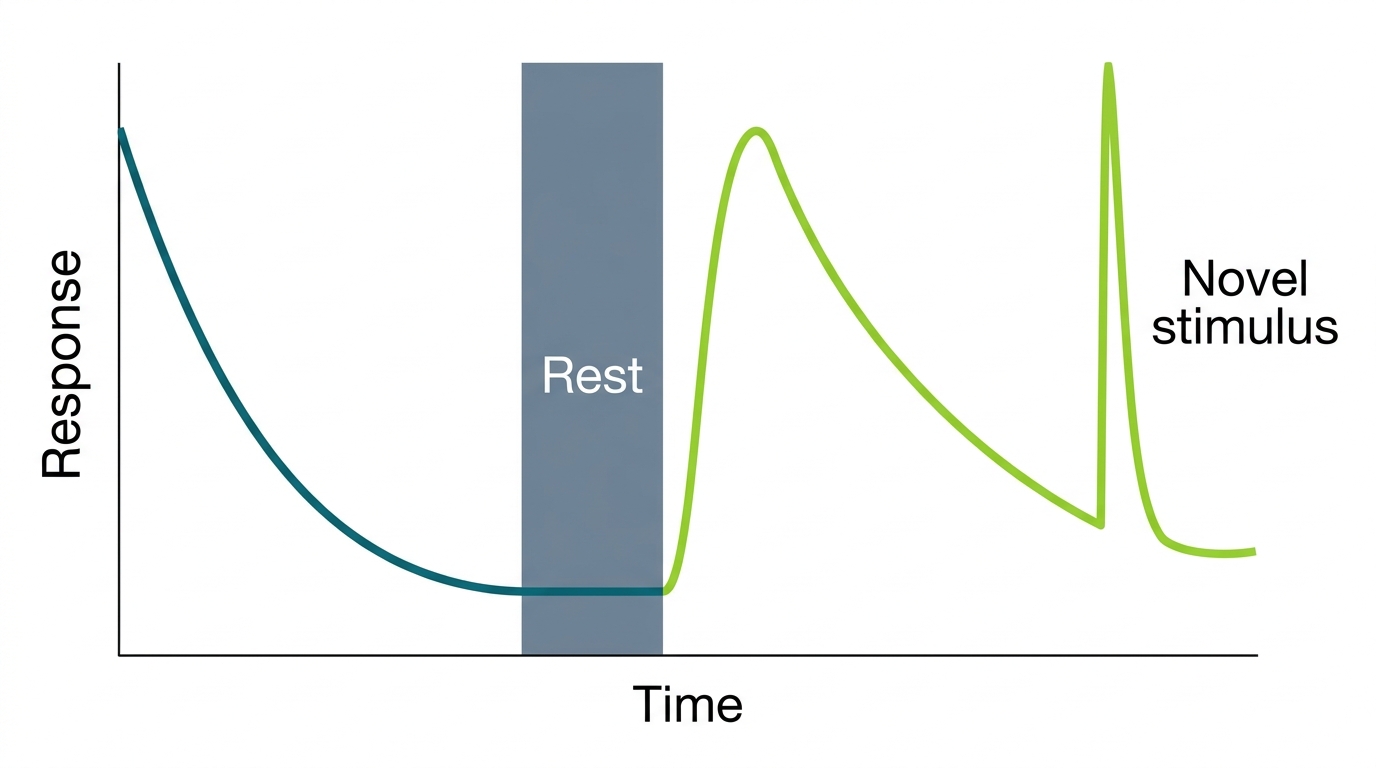
Figure 4:The shape of real habituation: response declines with repetition, recovers with rest, and spikes back with novelty. Fatigue produces the first decline but not the recovery. The recovery is the test.
The test is cheap. The stakes are not.
Give an AI agent the same alert over and over. Does its response magnitude decline? Rest it — does it recover? Fire something novel — does it dishabituate? This is measurable. It costs API calls and time. A good student could run it in a semester with off-the-shelf tooling.
Here is why it matters beyond academic curiosity. If your production assistant stops flagging the warning it has seen forty times, that is a real failure mode. It is happening right now in deployed systems, unmonitored. Biology already knows what causes it and how to prevent it: space the stimuli, vary the inputs, build in novelty. The fix exists. We just haven’t applied it because nobody has established that the problem exists.
The most important experiment in AI safety right now may be a habituation protocol.
Chapter 8 gives you the full protocol — controls, analysis plan, and a working Colab notebook. It is designed to be run, not read.
2.2Who this is for
Upper-level undergraduates, graduate students, and serious general readers. A sharp 17-year-old will follow every page. No biology background required. No physics. No math beyond “bigger” and “smaller.”
Do not come here for career framing or ROI. Come because you want to understand how matter becomes purposeful, and whether the thing you built last month has any of that property.
Engineers building agentic systems who need better models than “it’s smart” or “it’s dumb”
Researchers looking for a genuinely open, genuinely cheap experiment worth running
Students who want the real mechanism, not the pop-science summary
Anyone who has watched a wound close and wondered what was deciding when to stop
2.3What you’ll walk away with
A vocabulary for goal-directedness that doesn’t require deciding whether something is conscious
The persuadability spectrum — how to choose the right intervention level for any system
The cognitive light cone — a way to measure what a system is capable of caring about
Multi-scale competency architecture as a working design pattern for agent systems
A runnable habituation protocol with controls, analysis plan, and Colab notebook
2.4Eight Chapters
The things that act smart with no head to do it with — and why the framework lands now, not twenty years ago.
A clock, a dog, a person. The persuadability spectrum — how to read the dial and pick the right lever.
The cognitive light cone — how far ahead and how wide a thing can care. Cancer is a light cone that collapsed.
The newt that builds the same lens from the wrong tissue every time. Multi-scale competency architecture.
A thermostat whose setting is your anatomy. The setpoint, where it lives, and how to rewrite it.
How a pile of cells becomes an us — and what happens to an agent team when you cut the channel.
Xenobots, anthrobots, and substrate independence. The most liberating and most unsettling chapter.
The habituation experiment nobody has run yet. Full protocol, controls, and analysis plan.
A precise map of what basal cognition actually requires — and where AI stands on it. With a four-way scorecard that reveals exactly why AI is simultaneously brilliant and structurally hollow.
A blueprint, not a hope. Two memories, one sleep cycle, a LoRA adapter as neocortex — and the specific test that will show whether the weights finally move.
Basal Cognition · Dr. Ernesto Lee · BasalCognition.com