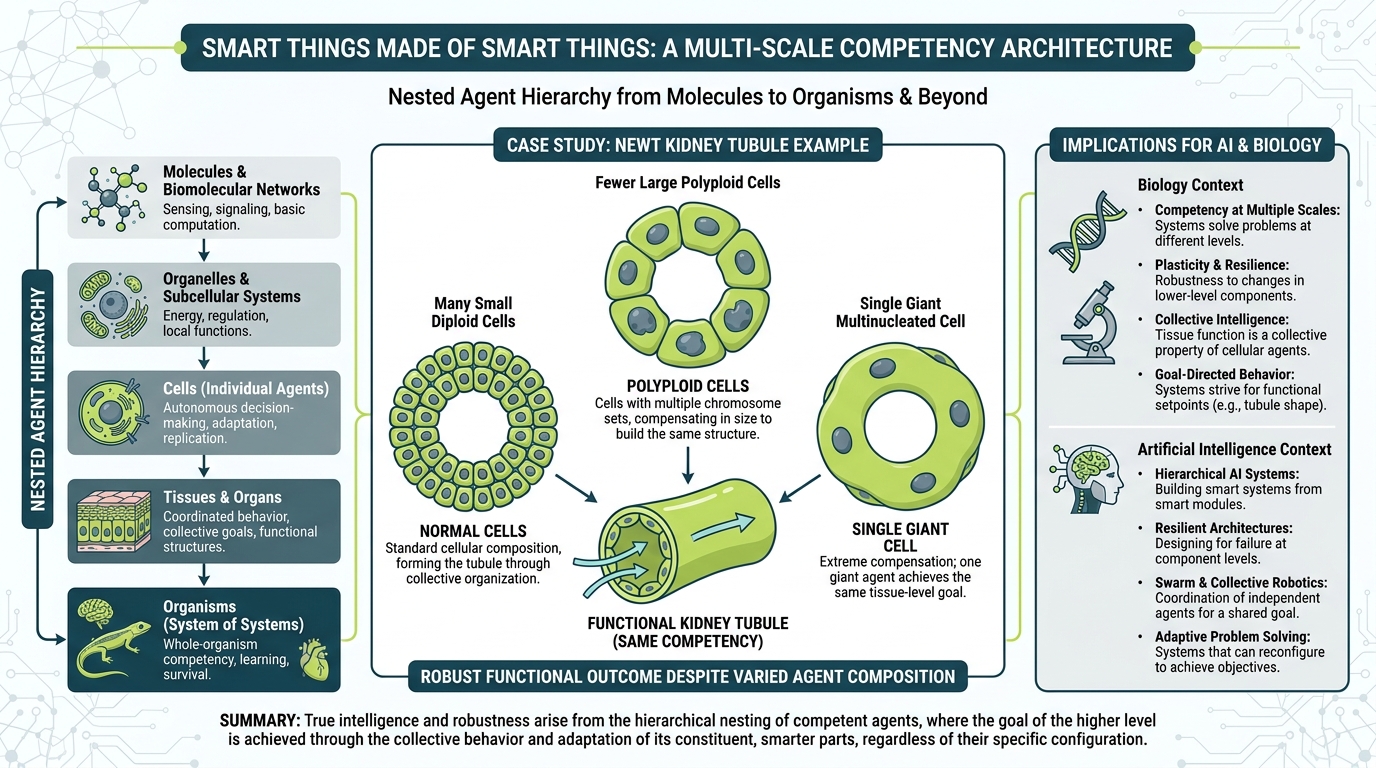
Figure 1:Smart things are made of smart things. Every level of a living system sets a goal and hands the work downward. The newt, the immune system, and the modern AI agent stack all run on the same logic.
A newt makes a kidney the same way every time. The tube at the center of each nephron — the part that filters your blood — comes out the same diameter, session after session, generation after generation.
Here is the strange part: the size of the cells doing the building does not matter.
Take a polyploid newt. Its cells are enlarged — twice, four times, even eight times the normal volume. A newt like that builds the same kidney tubule. It just uses fewer cells to do it. The tube stays the same. Only the cell count drops.
Push it to the limit. Find a newt with cells so enlarged that the math works out to one — one single cell to line the entire circumference of the tubule.
What does that cell do?
It wraps around itself. It bends its own membrane into a circle. It seals the ends. It builds the tubule alone — a structure that in a normal newt takes a coordinated effort from dozens of cells, accomplished here by a single cell performing a solo that evolution never rehearsed.
No new genes. No message that said: you are the only one, improvise. Nobody sent that instruction. The cell somehow read the situation — the absence of neighbors, the presence of an unfilled target — and found a solution that had never existed before in the history of that species.
Sit with that for a moment. This is a single cell. It has no brain, no nervous system, no way to “think” in any conventional sense. And it improvised.
That is not a reflex. Reflexes do not improvise. That is something else — something that happens when a system is organized around a target rather than a script.
No new genes. No new instructions. Nobody told that cell: you are the only one. Curl.
Sit in that for a second before moving on. This is not a weird edge case. This is a clear window into how life actually builds things.
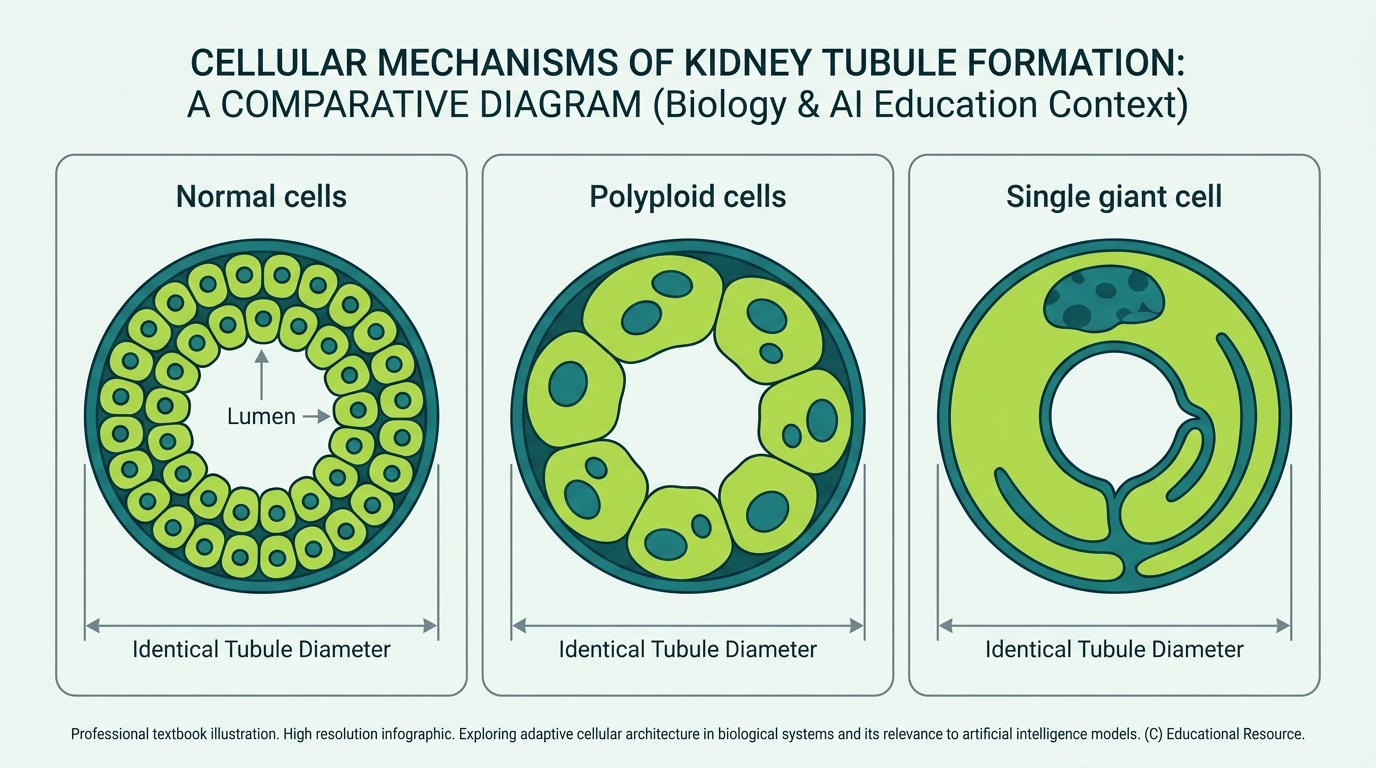
Figure 2:Three newts, three cell sizes, one tubule diameter. The genome did not change between them. What changed is how many cells answered the call. At the extreme right, one cell wraps around itself and forms the lumen alone — the most direct possible proof that cell count is not in the instructions.
1What a Blueprint Cannot Do
Here is a mental model you probably carry: the genome is a blueprint. DNA tells cells where to go, what to be, how many to make. Body = blueprint + execution.
That model is wrong. The newt just killed it.
A real blueprint specifies positions. A floor plan says: wall here, door here, window here. If you change the size of your bricks, your building stops matching the plan. You’d have to rewrite every measurement.
The newt’s genome did not get rewritten. Not one nucleotide changed between the regular newt and the giant-celled newt. The DNA didn’t know the cells were bigger. It didn’t need to know.
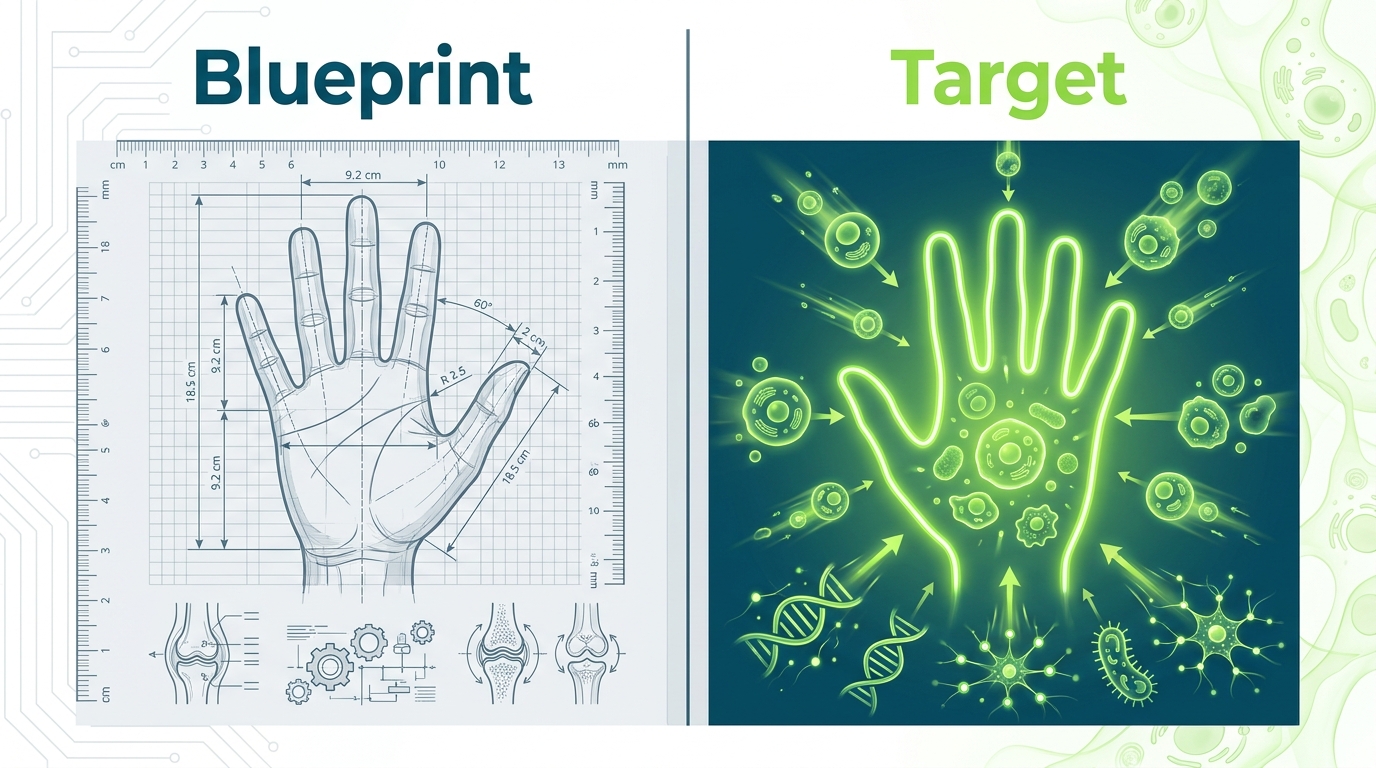
Figure 3:A blueprint encodes steps. A target encodes a destination. The newt experiment distinguishes them cleanly: the genome survives a 8-fold change in cell size without modification, which no blueprint could do.
What the genome does specify is the target shape. The tubule’s diameter. The lumen’s presence. The correct topology of the structure. What it leaves completely open is how many cells accomplish that shape, or what path each cell takes to get there.
The cells aren’t following a script. They’re solving for an outcome.
That is a different kind of intelligence than most people picture when they think about genetics.
2The Ladder
Biology has a question we kept answering wrong.
The question: which level is in charge?
Is the organism making the decisions? Or the organ? Or the cell? Or the protein? Pick your answer. Every textbook has a different one. And every answer is wrong in exactly the same way — it assumes one level owns the decision and everything else just executes.
That is not how it works.
A cell in your liver is solving a problem right now. So is the tissue that cell belongs to. So is the organ. So is you, the whole organism, reading this sentence. None of them is waiting. None of them delegated to the others. All of them are running simultaneously, each competent at its own scale, each solving for its own target, each producing outputs that become inputs for the levels above and below it.
Multi-scale competency architecture is the framework for taking that seriously.
MCA does not ask which level is in charge. It recognizes that every level is in charge — of its own domain — simultaneously.
The cell does not need to know what the organism is trying to do. The organism does not need to know which proteins the cell is assembling. Each level is sovereign. Each level is competent. And the system as a whole is far more robust than any of its levels, precisely because no single level needs to know everything.
Now run that same logic through biology — from molecule to cell to tissue to organ to organism to swarm — and you see the pattern everywhere.
Every living system is a nested stack of agents. Each level has its own goals. Each level monitors its own error signals. Each level has partial autonomy over how it achieves its outcome. And each level is built out of agents that are doing the same thing one rung down.
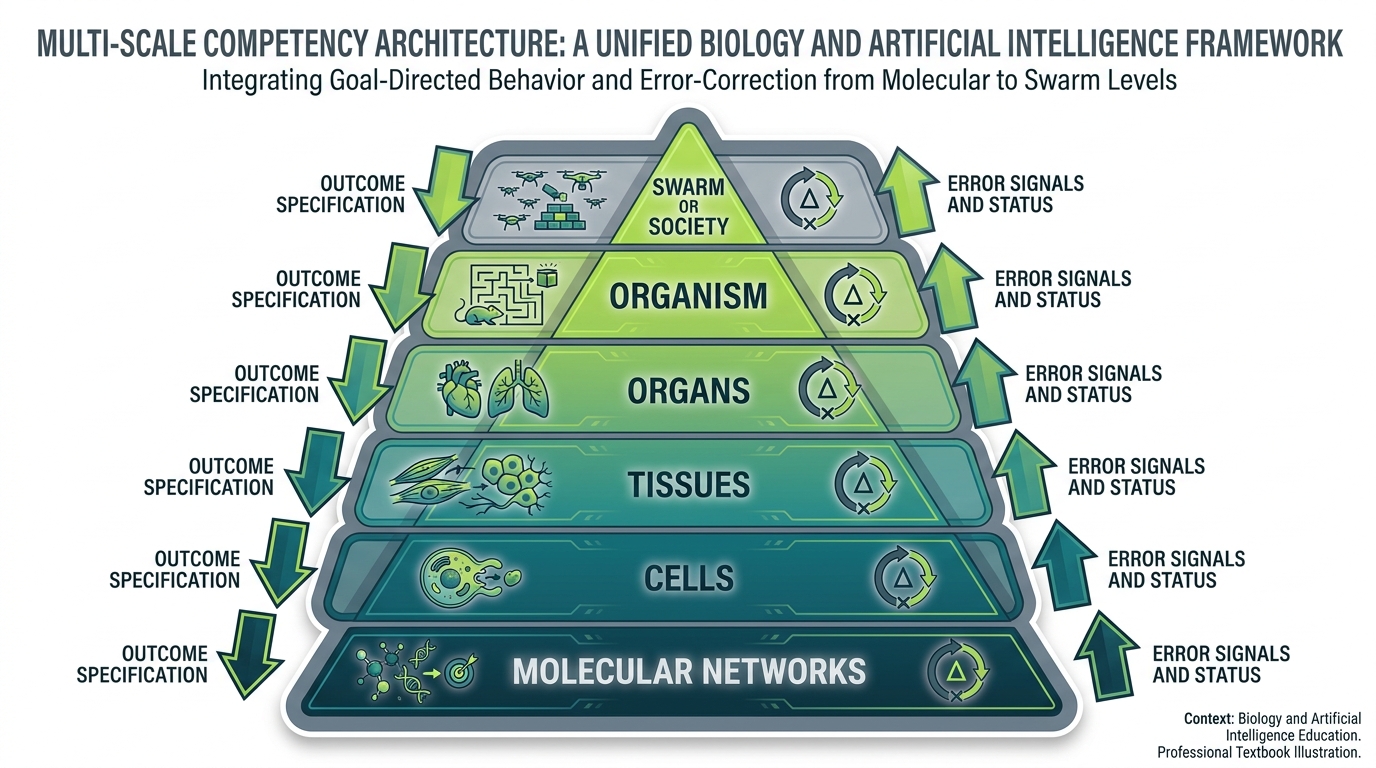
Figure 4:The competency stack. Each rung is a goal-directed agent. It receives an outcome from above and delegates means to the level below. Remove any rung and the system adapts — not perfectly, but more than a rigid machine ever could.
Start at the bottom. A protein network inside a single cell detects damage to DNA. It does not wait for instructions. It initiates repair. It has a goal — intact genome — and it pursues it through chemical gradients and feedback loops, with no cell nucleus telling it each step.
One rung up: the cell itself. It monitors its chemical environment, its mechanical neighbors, its position in a tissue. It makes decisions: divide, migrate, signal, die. A liver cell surrounded by healthy liver cells stays quiet. A liver cell in a wound edge proliferates. Same genome, different behavior, because the goal changed.
One rung up: tissue. A patch of skin knows it is supposed to be flat and sealed. A wound opens. The tissue does not wait for the brain to notice. Cells at the edge start migrating. Cells behind them divide. The patch closes and stops when the target is met.
One rung up: organ. A kidney regulates blood composition. It monitors dozens of parameters in parallel — pH, solute concentration, volume. It adjusts filtration rate. It talks to hormones. It has a setpoint and it defends it.
One rung up: organism. You wake up cold. You shiver. You reach for a blanket. You are running the same logic as every level below — goal, error signal, corrective action — just across a much wider range of possible goals.
One rung up: swarm, colony, society. A bee colony thermoregulates. Individual bees fan or cluster based on local temperature. No bee has the blueprint. The hive has the setpoint.
You need a name for this, because it keeps appearing. Cells doing it for tissues. Tissues doing it for organs. Organs doing it for organisms. Organisms doing it for colonies. The pattern is the same at every level, and once you see it you cannot unsee it. The newt’s kidney tubule is not a special case — it is the rule. Every level of biological organization is solving for an outcome rather than executing a script, and delegating the how to the level below.
The analogy breaks in one important place. Human organizational hierarchies often involve a boss who could do the subordinate’s job if needed. In biological MCA, the organism cannot do the kidney’s job directly. The levels are genuinely different in kind, not just scope. Keep that in mind when the metaphor gets tempting.
3How Levels Talk
The newt’s giant cell did not receive new instructions. What did it receive?
The answer is something like a signal about the current state of the target. Neighboring cells send chemical gradients. Mechanical tension tells a cell whether a gap still exists. Bioelectric fields across a tissue encode something about the overall pattern — Michael Levin’s lab has shown you can read and rewrite positional information through bioelectric manipulation alone.
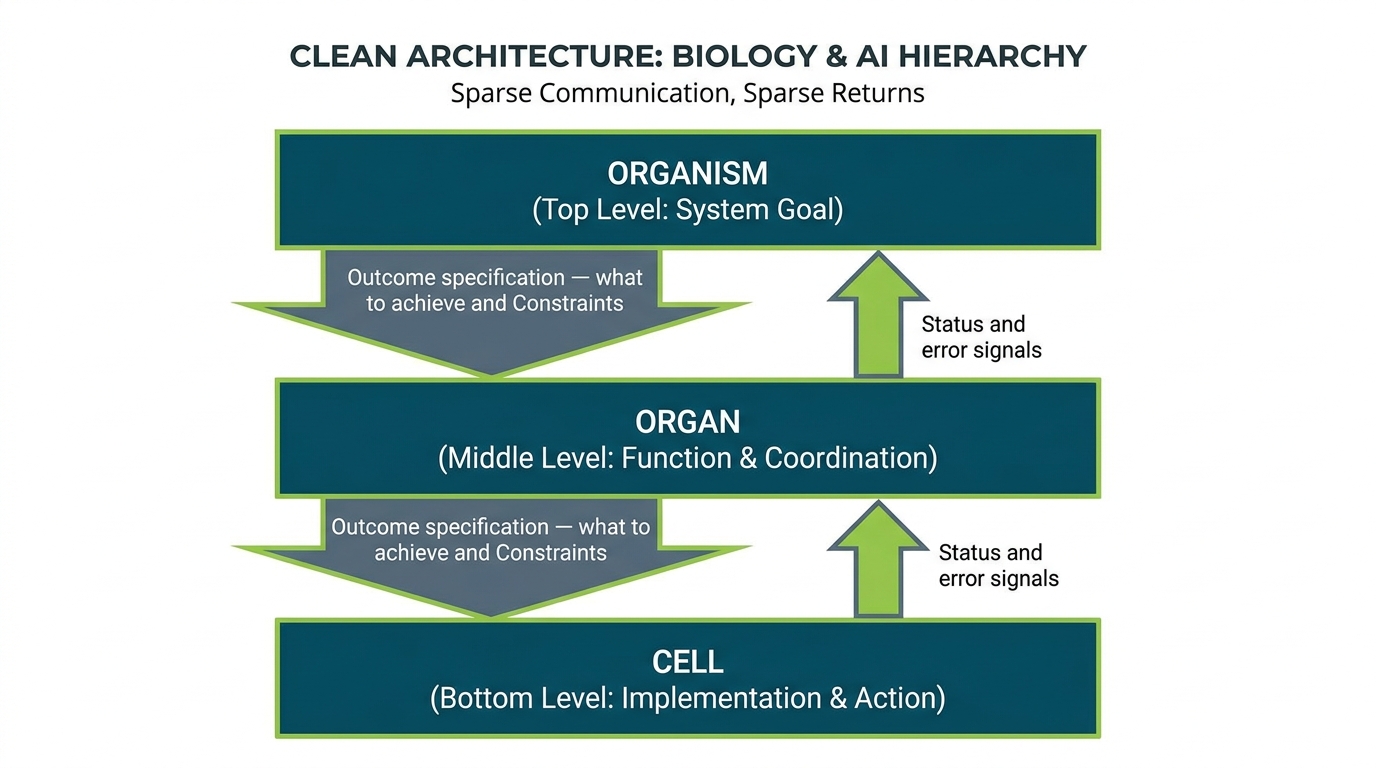
Figure 5:Information flows in two directions. Outcomes and constraints move down. Status and error signals move up. Notice what is absent: no level issues step-by-step instructions to a level two rungs below.
The information flowing down the hierarchy is sparse. Outcome. Constraint. Success signal. It is not a procedure manual. It is a destination address.
The information flowing up is equally sparse. Error magnitude. Current state. Whether the goal was met. Not a blow-by-blow account of every intermediate step.
This is the only way it can work at scale. A human brain has roughly 86 billion neurons. Your brain cannot track the behavior of each one individually. It specifies outcomes at a level of abstraction — move my hand — and trusts the motor cortex, the spinal cord, and eventually the muscle fiber networks to handle the details.
Micromanagement at scale is not just inefficient. It is physically impossible. The bandwidth does not exist.
4What You Get
Why bother with this design? What does MCA buy that a rigid, fully specified system cannot deliver?
Robustness to novel conditions.
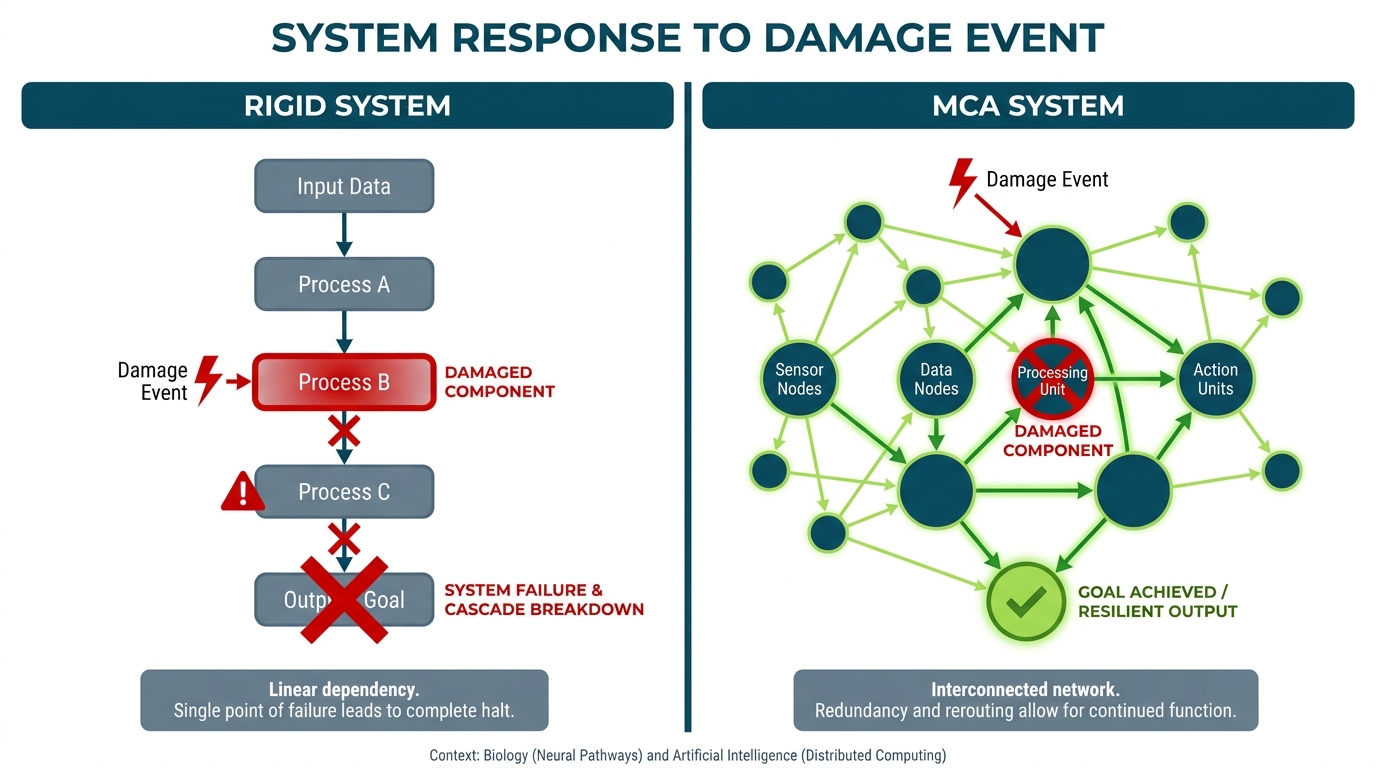
Figure 6:Rigid systems fail at their weakest link. MCA systems have no single weakest link — the goal is distributed. This is not magic; it comes directly from the fact that subordinate levels pursue outcomes, not scripts.
A designed system — a car engine, a circuit board, a traditional software pipeline — breaks when conditions fall outside its specification. The specifications were written by humans who imagined a range of conditions. Novel conditions outside that range break things.
An MCA system was never given a script to break. It was given a target. If the usual path to the target is blocked, the subordinate level searches for another path. It might not find one. It might find a bad one. But the default behavior is try again differently, not halt.
This is not theoretical. Consider:
Planarian flatworms cut in 279 pieces. Each piece regenerates a complete worm. The pieces were not designed to be standalone worms. They became worms because each fragment still contained cells that knew the target shape and could work toward it.
Embryonic development after cell splitting. Separate a human embryo at the four-cell stage. You can get four complete people from the cells of what would have been one. The cells were not individually programmed to be whole organisms. Each one still had the full target and the full competency.
Limb regeneration in axolotls. Remove the limb. The remaining tissue does not reference a “limb blueprint.” It reconstitutes one from local signals and target-seeking behavior across weeks of coordinated cell activity.
None of these require new genetic information. They require a system that pursues outcomes rather than executing steps.
Why cancers and birth defects are also MCA consequences
MCA gives you robustness. It also gives you the conditions for things to go wrong in ways a blueprint system never could.
A cancer cell does not malfunction in the sense of “executing the wrong instructions.” It de-integrates. It stops responding to the tissue-level goal signals. It runs its own cell-level goals — grow, divide, consume resources — without the tissue target to constrain it. The hierarchy loses a rung. The level above can no longer steer the level below.
Birth defects that involve extra or missing structures — extra digits, fused limbs, duplicated organs — often arise from miscalibrated targets, not wrong execution. The cells were competent. They hit their target. The target itself was set wrong. This is a different failure mode than a blueprint error and requires a different fix.
Levin’s lab has demonstrated that you can induce specific birth defects by altering bioelectric signals before the standard developmental instructions run. You change the target. The cells hit the new target faithfully. This means, in principle, you can also fix targets — and some regenerative medicine approaches are beginning to work exactly this way.
5What You Pay
MCA is not free.
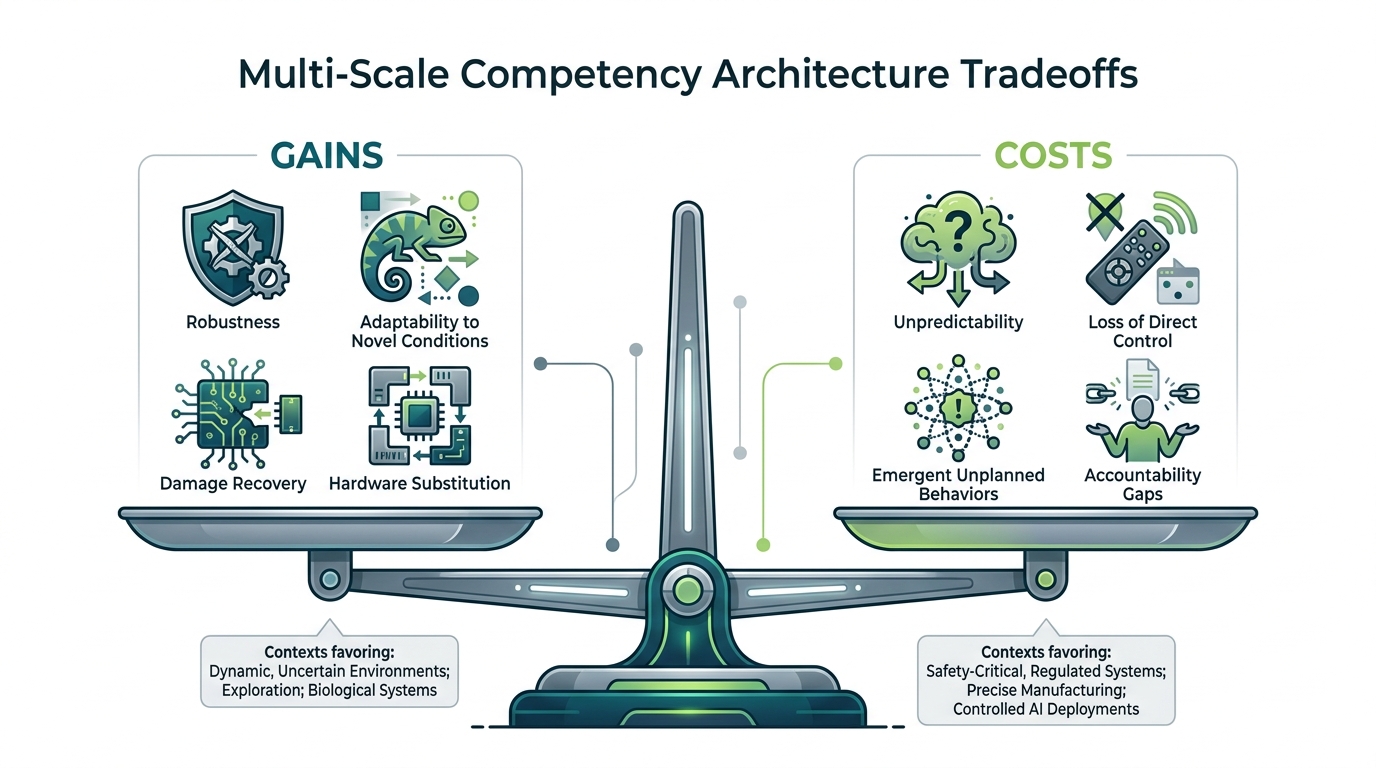
Figure 7:Every gain in MCA has a paired cost. Knowing both sides tells you when to use this design and when not to. A blood pressure cuff does not need MCA. A developing embryo does.
You give up predictability. When you specify outcomes and delegate means, the level below picks the means. Sometimes it picks means you did not anticipate. Sometimes it picks means you actively dislike.
This is not a bug in MCA. It is the mechanism. The robustness comes from exactly the same place as the unpredictability: the subordinate level has genuine agency.
You also give up direct control. You cannot override a lower level with high precision, because the channel between levels carries sparse information. Your brain cannot individually command each motor neuron in your hand. You can say grip with different force levels. You cannot say contract fiber 4,721 by 12 percent.
And you give up accountability. When something goes wrong in an MCA system, it is often genuinely hard to say which level caused it. Was it the target specification from above? Was it the execution strategy from below? Was it the signal channel between them? The answer is sometimes all three, entangled.
6MCA and AI Systems
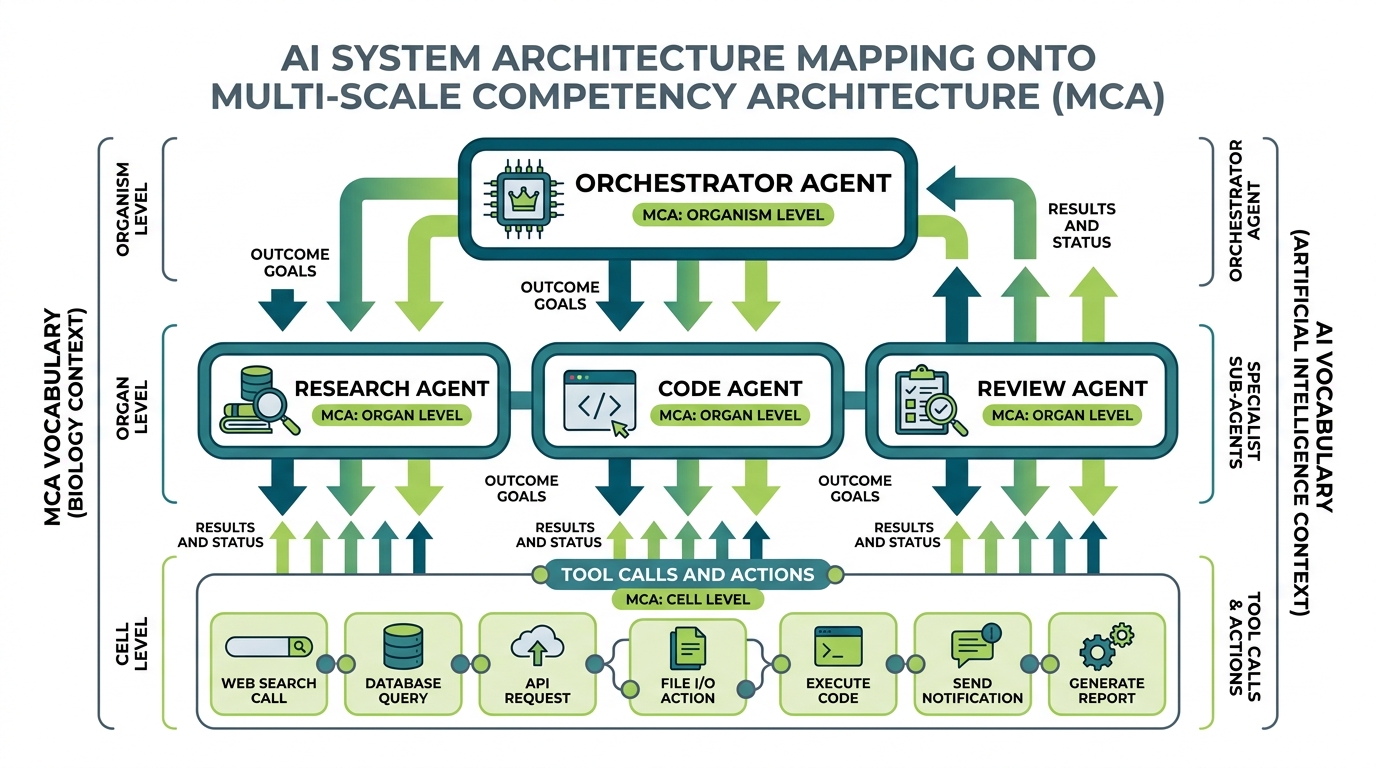
Figure 8:The orchestrator/sub-agent pattern is MCA. Most teams building these systems in 2025–2026 rediscovered it accidentally. The biology tells you what the failure modes are before you hit them.
In 2025, teams building production AI systems converged on the same pattern from different directions. An orchestrator model breaks a task into sub-tasks. Specialist sub-agents handle each sub-task. Results flow back up. The orchestrator synthesizes.
That is MCA. They built it without naming it, because the engineering pressure toward it is the same pressure biology faces: you cannot fit the whole problem in one place, so you divide competencies across levels.
The biology tells you exactly what breaks next.
Over-specification makes brittle sub-agents. If you give a sub-agent a 40-step procedure instead of a goal, it follows the procedure. When step 14 fails — because the external API changed, or the document format shifted — the agent stops. It has no goal to fall back on. It only has a script that no longer works.
Here is the same task written both ways. Read the left one and find the step where it dies.
Fetch open tickets from Product_Bug_Tracker via GET /v2/issues.
Filter to status=open.
Sort chronologically, oldest first.
For each ticket:
  1.  Open the ticket detail page.
  2.  Copy the description field.
  3.  Download every attachment to ./attachments/.
  4.  Open each attachment and read it.
  5.  Run sentiment analysis on the description.
  6.  Normalize the sentiment score to 0-1.
  7.  If score < 0.3, tag "urgent".
  8.  Post the tag back via PUT /v2/issues/{id}/tags.
  9.  Email the owner using the internal relay.
  10. Log the result to ./run.log.
Terminate when the list is exhausted.
Step 3 fails. The tracker moved attachments behind a signed URL last week. The agent has no goal to fall back on — only a script that no longer works. It stops, or worse, it continues and silently produces nothing.
Goal: every open bug report should carry an accurate urgency tag,
and the owner of anything urgent should know about it today.

Constraints:
  - Do not change ticket text or status.
  - Do not contact anyone outside the owner.
  - If you cannot read a ticket, flag it rather than guessing.

You have: the tracker API, the mail relay, and a sentiment model.
Step 3 has no equivalent to fail. Attachments were never the point. If the agent cannot open one, it still has the description, and it still knows what “done” means. It reroutes and finishes, or it flags what it could not read.
The difference is not prompt length. Both are about the same size. The difference is what the prompt encodes: a procedure or a destination.
Under-specification makes unpredictable sub-agents. Give a sub-agent only “do something useful about customer retention” and it has too much freedom. It might optimize a metric you did not mean to optimize. It might take an action outside the scope you intended. The biology has the same problem: tumor suppressor genes are part of the answer to keeping cells from running their own agenda without tissue-level constraint.
The real tradeoff, in one sentence: specify the outcome and the constraints, leave the method open.
That is harder than it sounds. You need to know which parts of the outcome are actually required and which parts you only think are required. Teams that get this wrong in one direction over-specify. Teams that get it wrong in the other direction lose control of what the agent does.
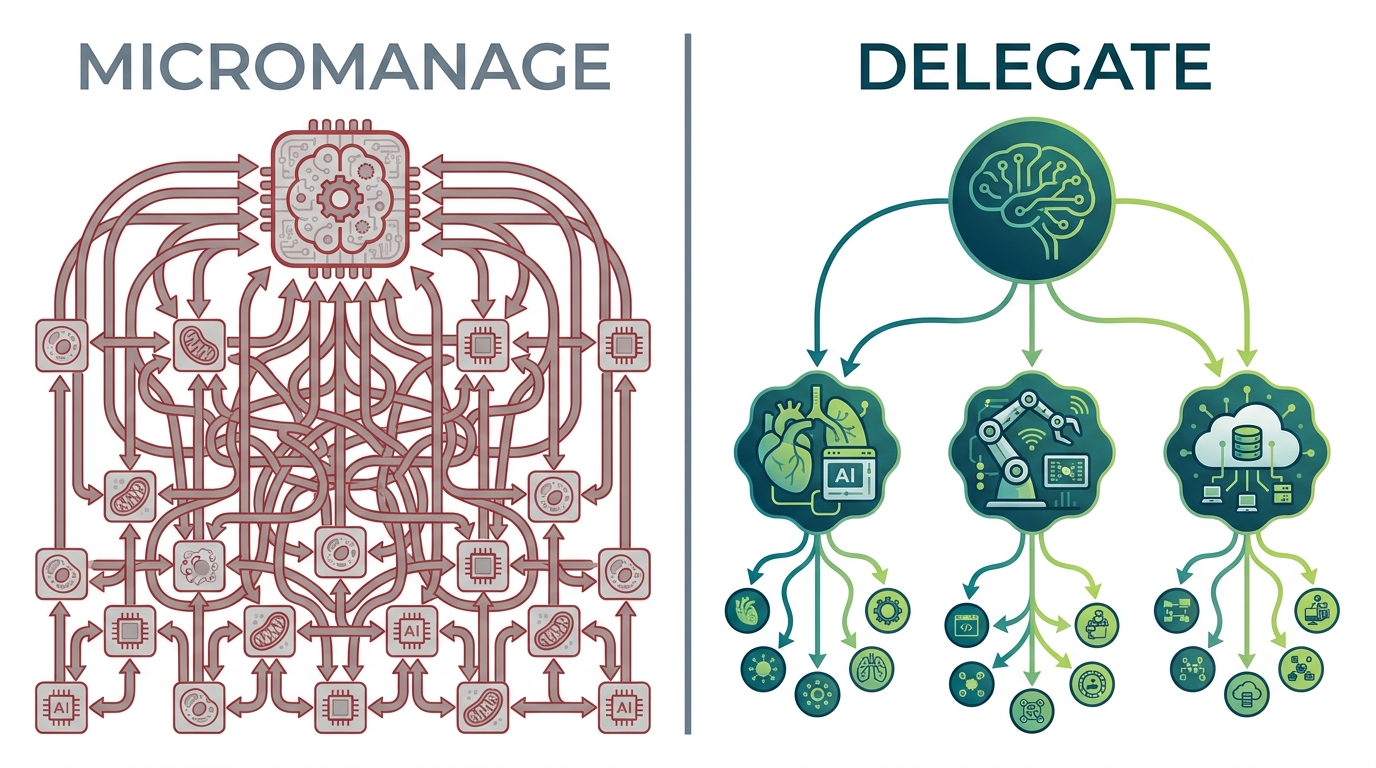
Figure 9:Micromanagement is not just bad management. It is bad architecture. When the level below must check back for every step, you have not built a competent subordinate — you have built a slow relay.
Biology handles the tension through three mechanisms that Chapter The Body Knows Its Own Shape and Chapter Glue cover in detail: setpoints (what done looks like), error signals (how far from done right now), and shared channels (the medium through which levels stay coordinated). Those three together are what let the kidney pursue its goal without the brain micromanaging each nephron.
Your AI agent stack needs equivalents. Not as a metaphor — as a literal design question. What is the sub-agent’s setpoint? What signal tells it when it has drifted? What channel do levels use to stay synchronized without the orchestrator reviewing every intermediate step?
If you cannot answer those three questions for a sub-agent you are deploying, you have not finished designing it.
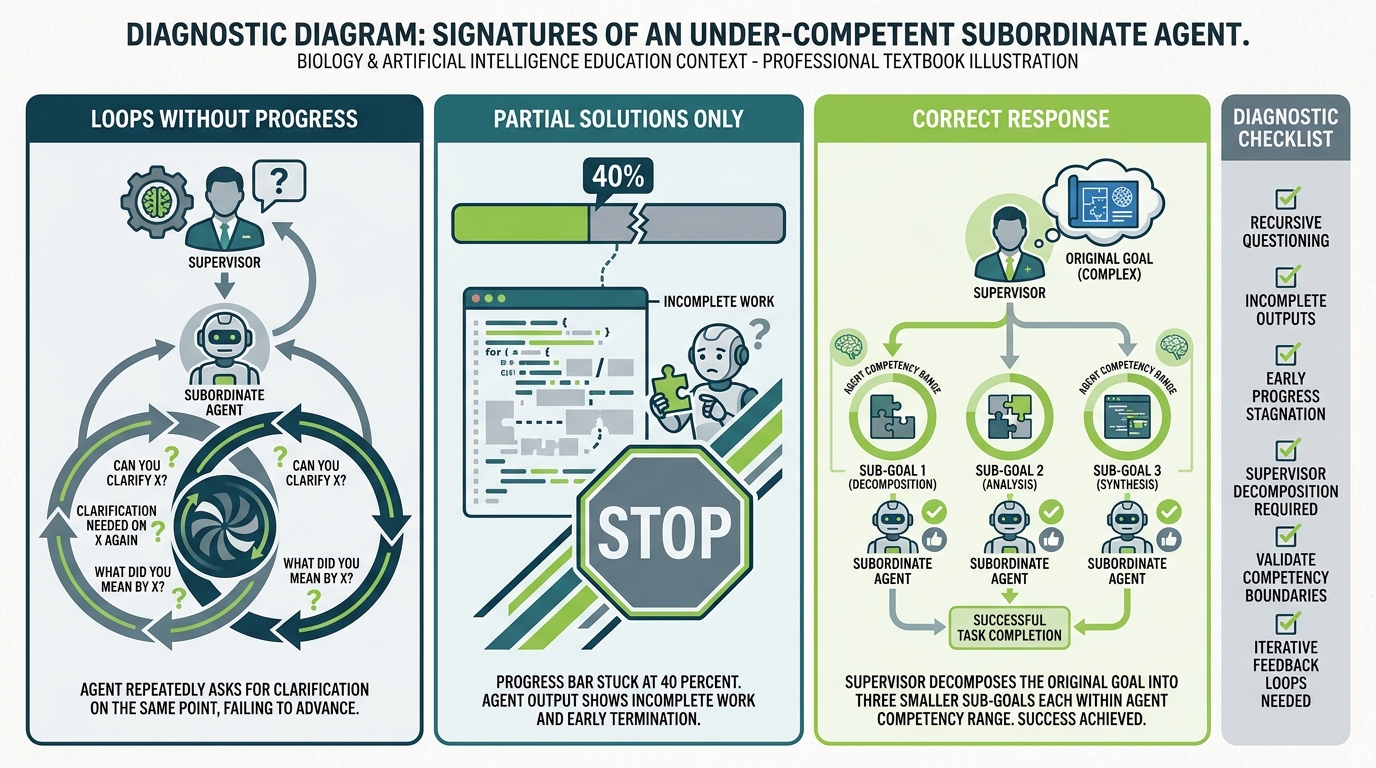
Figure 10:An under-competent subordinate has a diagnostic signature. It loops. It produces partial solutions. It asks for clarification repeatedly on the same point. The correct response is not to write better instructions — it is to shrink the goal until the agent’s competency matches the scope.
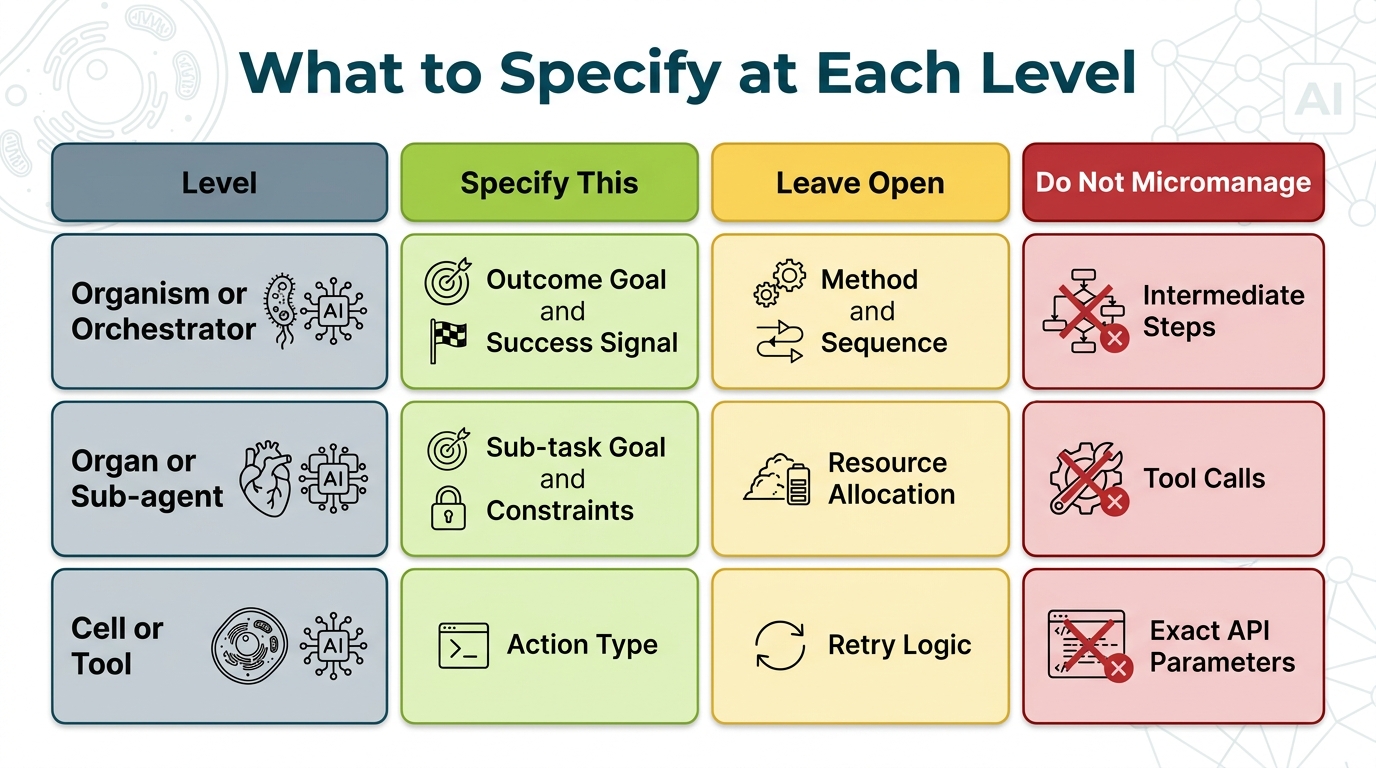
Figure 11:A practical rubric for MCA-informed agent design. The hardest column is the middle one — the constraints. Too few and you lose control. Too many and you have written a procedure with extra steps.
What biology specifies: target shape, boundary conditions, success signal (gap closed, osmolarity balanced, temperature stable)
What biology leaves open: which cells move, how many cells participate, which molecular path achieves the target
What happens when under-specified: cancer, teratoma, uncontrolled growth — the subordinate level runs its own agenda
What happens when over-specified: development fails to adapt to novel conditions — the organism cannot regenerate after damage it was not pre-programmed for
What you should specify: the outcome (what done looks like), constraints (what actions are off-limits), success signal (how the orchestrator knows)
What you should leave open: the method (search strategy, API calls, intermediate steps), the sequence (let the agent decide what to do first)
What happens when under-specified: agent optimizes a proxy metric, takes out-of-scope actions, produces outputs that satisfy the letter of the goal but not the intent
What happens when over-specified: agent fails when any intermediate step meets an unexpected condition; cannot adapt; brittle against environment changes
7🤔 Think About It
You are building a medical triage AI system. It takes a patient’s symptoms and test results and routes them to the right specialist.
The engineering team is arguing about how to prompt the routing sub-agent.
Option A: give it a detailed decision tree. Chest pain + shortness of breath + elevated troponin → cardiology. Fever + elevated white count → infectious disease. And so on, for 200 conditions.
Option B: give it the goal. “Route this patient to the specialist who can best address the primary complaint given the urgency level. Err toward the more serious specialist when uncertain.”
Option A fails when a patient presents with a condition not in the tree, or when two criteria conflict, or when the tree was built on population statistics that do not match this patient’s demographics. Option B might route incorrectly in ways that are harder to audit and harder to defend legally.
Both failures are real. Neither option is obviously correct.
Now layer in the biological analogy: an MCA system that handles routine cases well but surprises you in novel ones. What is the tissue-level goal the routing system should hold? What is the cell-level goal of the sub-agent? What does the error signal look like when routing goes wrong — and who reads it?
There is no clean answer. But work through the failure modes for each option. Which one fails dangerously? Which one fails visibly? And is there a third design that borrows the “setpoint + error signal” structure from biology to get the best of both?
8💬 Discussion
Prompt: Pick a system you interact with daily — a hospital, a school, a city government, an app. Describe one place where that system behaves like it is specifying outcomes and delegating means (working well), and one place where it behaves like it is issuing step-by-step procedures from the top (breaking down). Use the vocabulary from this chapter: goal, competency, error signal, level, setpoint. Do not use the word “hierarchy” as a substitute for thinking — say what the levels actually are.
Discussion Guidelines
Support your main post with at least one credible source, cited.
Reply to at least two classmates with substantial feedback — extend, challenge, or add evidence. “I agree” is not a reply.
9🔬 Hands-On Lab: Build a Two-Level Agent
You do not need to write code. You need a browser and access to any AI assistant.
Part 1 — Outcome specification. Pick a task: plan a week of meals, outline a research paper, draft a project timeline. Write two prompts for the same task. The first is a step-by-step procedure (tell the AI exactly what to do in what order). The second specifies only the outcome and constraints (what done looks like, what is off-limits, nothing else). Run both. Compare the outputs.
Part 2 — Stress-test. Introduce a novel condition the procedure would not handle: “Oh, one person is allergic to gluten and we have no oven this week.” Run both prompts again with the new constraint. Does the procedure-following version adapt? Does the outcome-specified version?
Part 3 — Reflect. Write one paragraph connecting what you observed to the newt tubule experiment. What is the genome analog in your prompt? What is the cell?
Group Build:
Use AI to identify a real problem in your own context.
Use AI to develop a solution to it.
Be ready to tell the class: what problem, how AI helped, what the solution looks like, and what the AI got right or missed.
10🐍 Optional Advanced Lab: Simulating MCA in Python

You will build a simple two-level MCA simulation. A top-level “organism” agent holds a target value. A set of “cell” agents each observe local conditions and push values toward the target. The organism never tells any cell what to do — it only broadcasts the current error signal. You will observe how the system reaches the target, then damage one cell agent and watch the others compensate.
11🎯 In-Class Assignment: Mapping Competency Levels (10 pts)
Details and instructions will be provided in class.
Points: 10
12📖 Glossary
Term | Definition |
|---|---|
Multi-scale competency architecture (MCA) | The organizational pattern in which a system is built from nested layers of goal-directed agents, each specifying outcomes for the layer below while pursuing its own goal for the layer above. |
Target morphology | The destination shape or state that a developing structure is working toward — distinct from a blueprint because it can be achieved by different cell numbers, sizes, and paths. |
Outcome specification | Telling a subordinate level what to achieve, not how to achieve it. The defining feature of MCA-style communication between levels. |
Process specification | Telling a subordinate level the exact steps to follow. Works when conditions are stable and predictable; breaks when they are not. |
Setpoint | The target value a system is defending. A thermostat has a setpoint of 72°F. A kidney has a setpoint for blood pH. An AI sub-agent should have an explicit setpoint for what done looks like. |
Error signal | The difference between the current state and the setpoint. Every MCA level monitors this and takes corrective action when it is non-zero. |
Polyploidy | Having more than the standard two copies of each chromosome. Polyploid cells are larger than normal. The newt experiments exploit polyploid salamanders to produce enlarged cells with the same genome. |
Lumen | The hollow interior of a tube-shaped structure. In the kidney tubule, the lumen is what must form — regardless of how many cells wall it off. |
Delegation | Transferring an outcome goal to a subordinate level while leaving the method open. The opposite of micromanagement, and the signature of MCA. |
Robustness | The ability of a system to achieve its goal across a wide range of conditions, including conditions it was not specifically prepared for. |
Orchestrator | In an AI agent system, the top-level model that breaks a task into sub-tasks and assigns them to specialist sub-agents. The biological analog is the organism level in MCA. |
Sub-agent | A specialist AI model that handles one sub-task within a larger system. The biological analog is an organ or tissue that pursues a specific goal within the whole organism. |
TAME framework | Technological Approach to Mind Everywhere — Michael Levin’s framework for applying cognition vocabulary (goal, error, memory, learning) to non-neural systems at all biological scales. |
Bioelectric signaling | The use of voltage gradients and ion flows across cell membranes to encode positional and pattern information. A key channel through which levels in MCA communicate target morphology. |
De-integration | The loss of responsiveness to higher-level goal signals. A cell that de-integrates pursues its own local goals without the tissue target to constrain it. Cancer is the clearest biological example. |
Competency level | The scale at which a given agent pursues goals. A cell’s competency level is its local chemical neighborhood. An organism’s competency level spans its entire body and into its future. |
Regeneration | The reconstruction of a lost structure by goal-seeking behavior at lower competency levels. Planarian regrowth, axolotl limb replacement, and wound healing all involve target-seeking without new instructions. |
13🔑 The Takeaway
A newt with giant cells builds the same kidney tubule. One enormous cell wraps around itself to form the tube alone. The genome did not change. The cell count was not in the instructions.
The genome specifies target shapes, not execution paths. That is the only reading consistent with the evidence.
Life is a nested stack of goal-directed agents. Each level pursues outcomes, delegates means, and monitors error signals. This is multi-scale competency architecture.
The robustness of living systems comes directly from outcome specification. You cannot break a system that is pursuing a goal by changing the route — only by changing the goal or cutting the signal.
The cost is real: you lose predictability and direct control. Cancer, teratoma, and misaligned AI agents are all MCA failure modes.
Every orchestrator/sub-agent AI architecture is a rediscovery of MCA. The biology tells you what breaks before you hit it.
Specify outcome and constraints. Leave method open. Verify the sub-agent has a setpoint, an error signal, and a channel. If you cannot answer those three questions, you have not finished the design.